
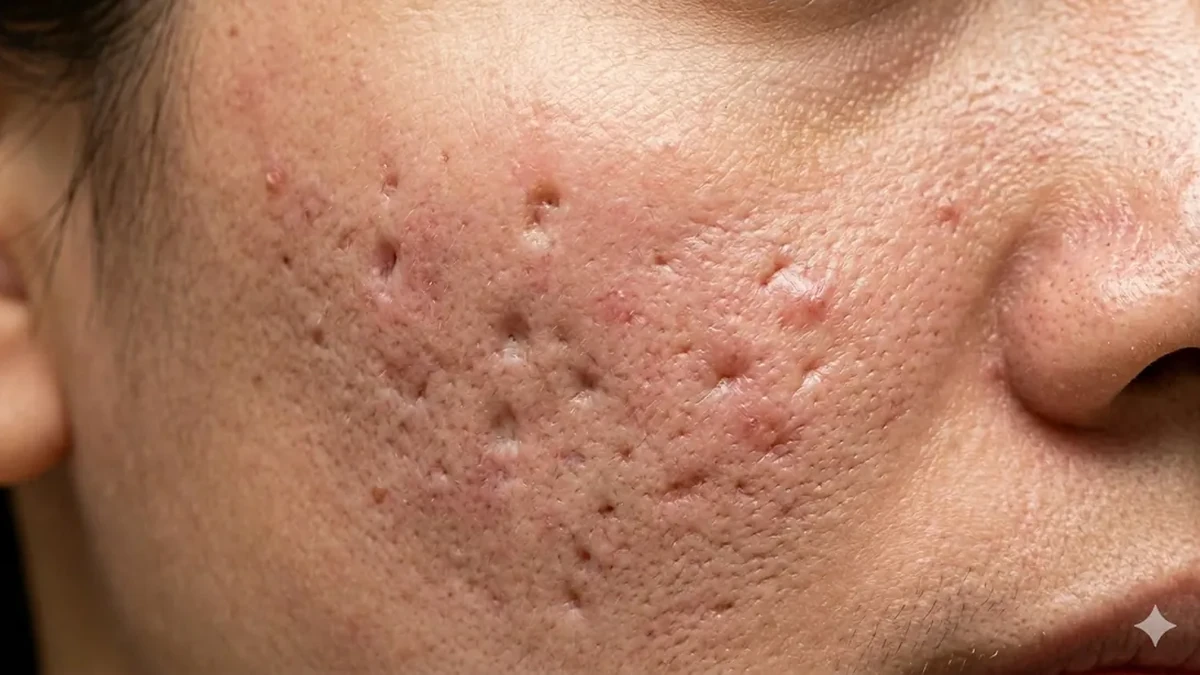
Depressed acne scars are one of those things that can feel especially unfair. The skin was smooth, an inflamed spot appeared, and even after the acne settled it left a dip behind. For me, acne-scar treatment starts by understanding what happened to the skin—not by assuming every mark needs exactly the same procedure.
How does an acne scar form?
Inflammation can damage collagen and other skin structures. During healing, some tissue may be lost, and in certain scars fibrous bands can tether the surface downward. Both lost tissue and tethering can contribute to an uneven appearance. Not every scar has the same mechanism.
Rolling, boxcar and ice-pick scars: why the labels matter
Rolling scars tend to have broader, sloping edges and may be tethered. Boxcar scars are often more sharply defined, and ice-pick scars are narrow and deep. Real faces often contain a mixture. That matters because the best approach for one scar shape may do very little for another.
When do I think about subcision?
If a scar appears tethered, especially a suitable rolling scar, subcision may be discussed to release some of those deeper attachments. It is not something every person with acne scars needs, and it is not a guarantee that the surface will spring back to perfect smoothness.
Releasing a tether may not be the whole treatment
After looking at the deeper attachments, we still have to think about texture and the tissue above them. Different procedures may have roles depending on scar type. PN/PDRN preparations and other injectables deserve careful consideration of the actual evidence and intended use; they should not be presented as automatic substitutes for established scar procedures.
Our clinic does not currently offer acne-scar laser treatment
Laser resurfacing is one option discussed in acne-scar care more broadly, but it isn't a service we currently provide for this purpose. I'd rather be clear about that than write an article that gives someone the wrong expectation when they arrive.
Why some people need three to five sessions—or more
Scar treatment usually involves gradual improvement rather than one dramatic reset. In my experience, some people return for several sessions, sometimes in that range, but there is no fixed number for every face. Scar depth, type, healing and the plan all influence what makes sense next. We should keep reassessing whether further sessions are worthwhile.
What should I know about the risks?
Depending on the procedure, there may be bruising, swelling, infection, pigment changes or further scarring. Active acne needs managing too, otherwise new scars may continue to develop while we are treating old ones. I don't want anybody choosing a procedure without understanding the possible downsides.
Is it really improving, or did the lighting change?
Lighting makes an enormous difference to how depressed scars look in photos. I prefer before-and-after comparisons using similar angles and lighting. If one scar isn't improving, let's reassess its type and the plan rather than claim a percentage based on one flattering photograph.
Questions patients ask
Does every acne scar have a fibrous tether?
No. That is why scar classification matters before considering subcision.
Can treatment restore the skin to 100% of what it was?
I wouldn't promise that. The realistic goal is improvement in texture and appearance, with results varying from person to person.